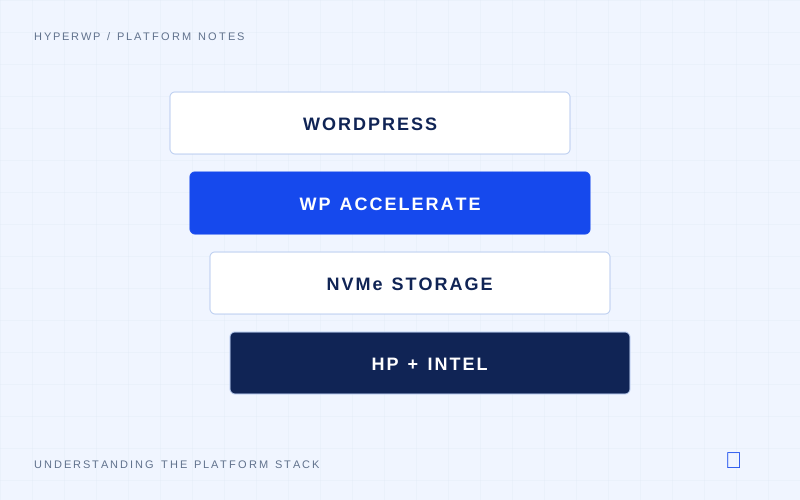
Each page request can involve several parts of the hosting stack before the browser can show the result.
Behind it, there is more going on. WordPress builds the page. Our cache can keep a copy. The server runs code and holds the data. At HyperWP, we choose each part with that work in mind.
Each handles a different part of a request. The amount of work at each layer depends on the page, its data and the cache state.
WordPress brings the page together
Your theme sets out the page. Plugins add features. The site’s data supplies things such as posts, settings and product details.
When a request cannot use a cached page, WordPress runs the theme and plugin code and retrieves the required data. That takes work, and more complex pages can take more of it.
Two sites on the same plan may therefore have different response times. A page with more plugin code or database queries can need more work to build.
Caching and request handling
We use WP Accelerate to cache results that are safe to use again. A saved answer can spare the server some work on the next visit.
That is useful when many readers want the same content. Pages with private or changing data need different rules. Cache rules must account for which content can be shared and when it changes.
CPU processing and storage access
The CPU runs the code. The drives hold files and data that need to be read or saved. Each has its own job.
Our standard plans use Intel Silver CPUs. Our high-frequency plans use Intel Gold CPUs. NVMe drives hold the data. All of this sits on our HP-based servers.
Memory and caches may already hold some of the data. So not every visit needs to touch every part in the same way.
Browser rendering
After the server sends a response, the browser still has work to do. The browser must turn it into something you can see and use.
Large images, heavy scripts or calls to other sites can add a wait at this stage. A quick server helps, but it cannot erase every delay that comes after it.
That is why our demo theme keeps things light. The platform and the page should both do their share.
These parts make up what we call the stack. That just means the tools and hardware that work together. Each visit may need a different mix of them. Page speed is the combined result of this server work and the browser’s work.